A digital business card is faster, cheaper and always current. It is also, in the wrong moment, mildly awkward — asking a senior client to scan a code across a dinner table does not always land the way you intend. Etiquette here is not about technology preference; it is about reading the situation. Here is when the QR card wins and when the paper one still does.
The case for the QR card
The practical arguments are strong. A digital card cannot run out, cannot be left in the other jacket, and cannot go stale when you change your job title or number — you update it once and every future share is correct.
It also skips a step for the recipient: instead of a card that has to be scanned or typed later, your details land straight in their phone. We covered the mechanics of setting one up in how to create and share a digital business card by QR or link.
When paper still wins
Three situations, reliably. Formal introductions in markets where the card exchange is itself a ritual — Japan being the clearest example, where the card is presented with both hands and read before being put away. Very senior contacts who are not going to take their phone out for you. And any moment where producing a phone would break the tone: a funeral, a board dinner, a hospital corridor.
In those settings, a paper card is not a fallback, it is the correct instrument. Carry a few.
Reading the room in three seconds
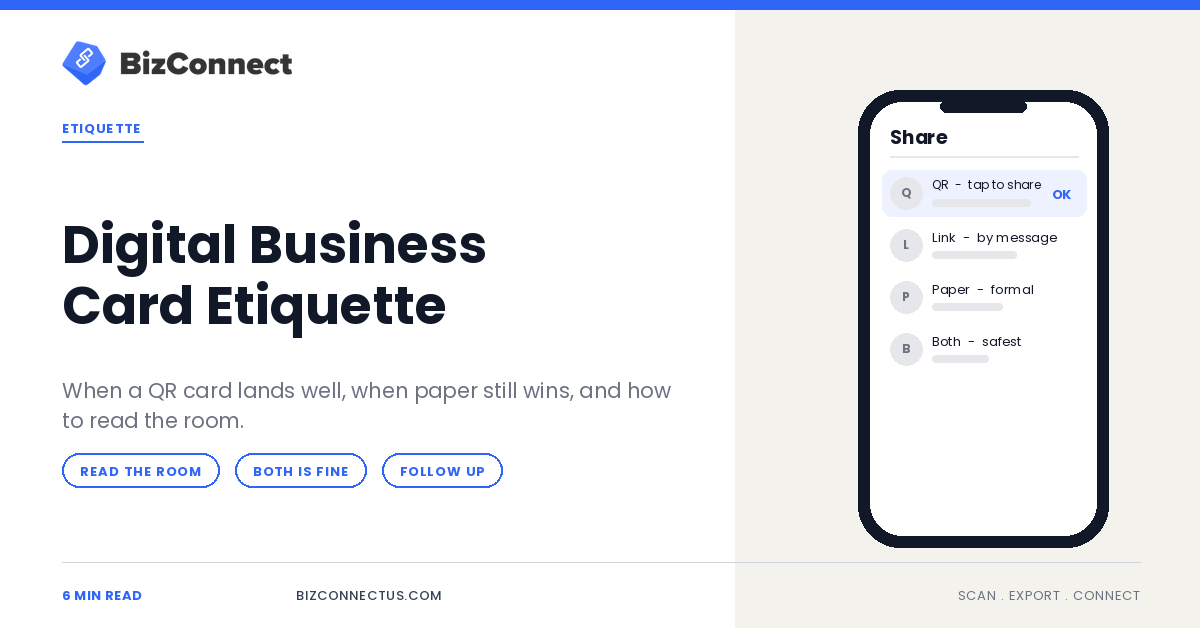
The usable heuristic: if their phone is already in their hand, offer the QR. If it is in their pocket and the setting is formal, offer paper. If you cannot tell, offer paper and mention that you will send the digital version by message — that covers both without making anyone choose.
Never make someone hunt for their phone, and never hold your screen up expectantly. The card should feel offered, not demanded.
The group-setting problem
QR cards are at their best in a group, because one code serves five people at once with no fumbling through a wallet. They are at their worst in a queue or a moving crowd, where people cannot stop long enough to focus a camera.
At a busy stand, the smoother move is to scan their card rather than share yours. It takes one second of their time instead of ten of yours, and it puts the follow-up obligation on you — which is where you want it anyway.
Whichever direction it goes, capture it
The etiquette question distracts from the operational one. However the exchange happens, someone has to end up with usable contact data, and paper cards handed to you are still the most common form of that.
Scan them the same day rather than at the end of the week. A card scanner that reads 30+ languages and exports to Google Contacts, Outlook, Excel, Salesforce, HubSpot and Zoho handles the paper half of the exchange, and BizConnect does both sides — digital card and scanner in one app. Our honest look at whether digital business cards are worth it covers where they genuinely replace paper and where they do not.
Following up is the actual etiquette
A card exchanged and never followed up is worse than no exchange, because it registers as mild disinterest. If you took someone’s details, use them within a few days, reference something specific from the conversation, and keep it short.
This is also where digital cards quietly help: your link in the signature of that follow-up gives them a second, frictionless chance to save your details at a moment when they are actually at a desk.
Carry both and stop worrying about it
The whole debate resolves neatly. Keep ten paper cards in the wallet for formal and senior moments, keep the QR ready for everything else, and let the setting choose. Nobody has ever been criticised for having both.
BizConnect handles the digital card and the scanning of everyone else’s paper in one place, free for up to 50 cards a day, on Google Play. If your team is standardising how it presents itself, why sales teams are moving to digital cards makes the organisational case.
Frequently Asked Questions
Is it rude to share a digital business card instead of paper?
Not in most settings. It becomes awkward in formal introductions, with very senior contacts, or anywhere producing a phone breaks the tone. Carry a few paper cards for those moments.
Should I still carry paper business cards in 2026?
Yes, a small number. Paper remains the correct instrument for formal exchanges and in markets where the card ritual matters, such as Japan.
What is the polite way to offer a QR card?
Offer it when their phone is already in their hand, and never hold your screen up expectantly. If in doubt, hand over paper and say you will send the digital version by message.
Is it better to scan their card or share mine?
In a busy setting, scan theirs. It takes less of their time and leaves the follow-up obligation with you, which is where it belongs.
Can one app do both digital cards and scanning?
Yes. BizConnect includes a QR digital card alongside the scanner, so you can share your details and capture theirs from the same place.