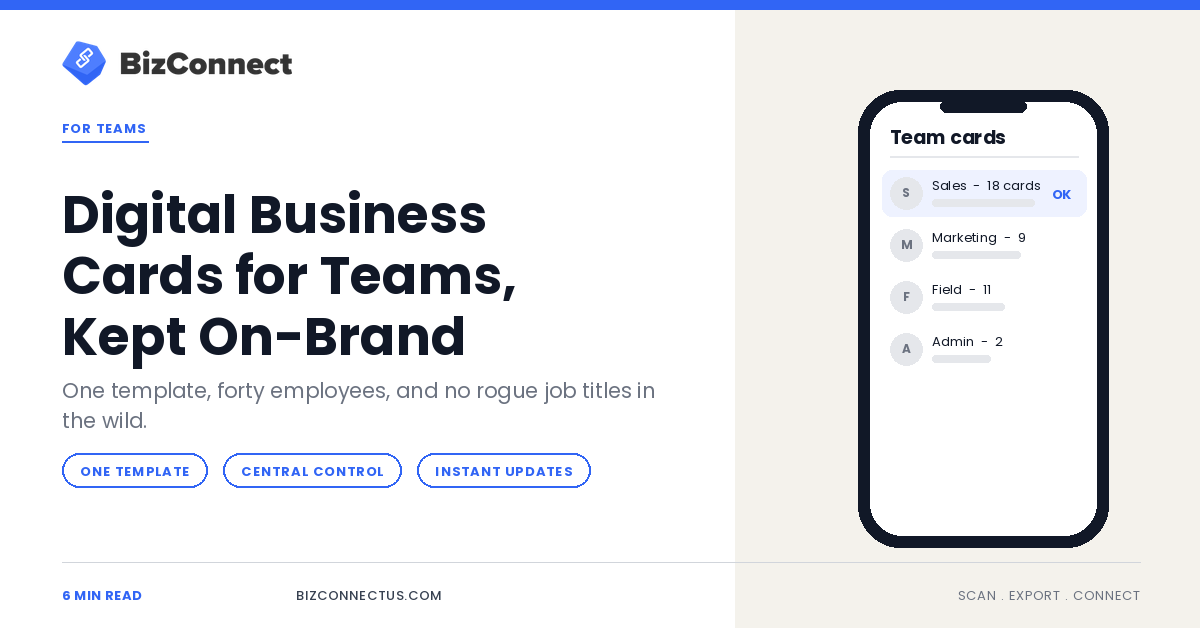
Give forty employees a digital business card and, left alone, you will get forty different cards — mismatched logos, invented job titles, a personal Gmail address on one, an old office number on another. The technology is easy. Keeping the output consistent is the actual project, and it is worth planning before the rollout rather than after.
Why individual cards drift
It is not defiance. Someone gets promoted and edits their own title to something plausible but non-standard. Someone adds a personal mobile because that is the number clients actually use. A new starter copies the format from whoever sat next to them, complete with a typo that then propagates.
Within a year the cards no longer look like they come from the same company, which is the one thing a business card is supposed to communicate.
Decide what is fixed and what is personal
Draw the line explicitly before you roll out. Fixed: logo, colours, company name, legal entity, website, the format of job titles, and the office address. Personal: name, title text drawn from an approved list, direct number, email, and optionally a photo.
The mistake is leaving job titles fully free-text. Titles are where drift starts, because they change most often and everyone has an opinion about their own.
Central control is the whole feature
A team digital card system is only as good as its admin layer. You want one place to add a starter, revoke a leaver, push a design change to everyone, and see who actually has a card.
BizConnect’s team plan includes a shared contact database with an admin dashboard and role-based access, and a web console for doing this on a laptop rather than a phone. The mechanics overlap heavily with running one business card app across a sales team — same admin surface, applied to outbound cards instead of inbound scans.
The leaver problem nobody plans for
Paper cards walk out of the building with the person, which is annoying but harmless. A digital card is different: it is a live link, and if nobody revokes it, a former employee continues to hand out a card with your branding and a working link for as long as they like.
Add card revocation to the offboarding checklist alongside email and building access. It takes ten seconds if the admin layer exists and is impossible if it does not.
Updates should be instant and silent
The strongest argument for team digital cards is that a rebrand, an office move or a phone-system change propagates immediately. Nobody reprints, nobody hands out stock with an old address for eight months while it runs down.
Test this before you commit: change a detail centrally and confirm that an already-shared card reflects it. A system where updates only apply to cards shared from that point onward gives you most of the cost and none of the benefit.
Rolling it out so people actually use it
Pilot with one team — usually sales, because they share contact details most often and will find the friction fastest. Give them the template, watch what they try to change, and decide whether each request is a legitimate gap or the beginning of drift.
Then roll out with a short standard: here is your card, here is how you share it, here is who to ask for changes. Pair it with the inbound side so the team is scanning as well as sharing — our piece on why sales teams are replacing paper is a useful internal explainer.
What good looks like six months in
Every employee card uses the same template. Titles come from an approved list. Leavers’ cards are dead. A change to the office address takes one edit. And the cards people actually share look like they came from one company, because they did.
None of that requires an expensive platform — it requires an admin layer and a decision about what is fixed. BizConnect covers the digital card and the scanner in one app, with Enterprise licensing at $399.99 a year for ten or more seats, and is available on Google Play. If you are still weighing the format itself, our honest assessment of digital cards is the place to start.
Frequently Asked Questions
How do I keep employee digital business cards consistent?
Fix the logo, colours, company details and job-title format centrally, and leave only name, title, direct number and email as personal fields. Free-text job titles are where consistency usually breaks.
What happens to a digital card when an employee leaves?
It stays live unless revoked, so add card revocation to your offboarding checklist alongside email and building access.
Do card updates apply to cards already shared?
They should. Test it before committing — confirm that editing a detail centrally updates a card that was shared previously, not just future shares.
What does a team plan cost?
BizConnect's Enterprise tier is $399.99 per year for ten or more licences, which includes the shared contact database, admin dashboard and role-based access.
Should the team still carry paper cards?
A small number, for formal introductions and senior meetings. The digital card handles everyday exchanges and keeps details current.